The strength and conditioning industry is currently navigating a significant philosophical divide regarding the optimal training protocols for the aging adult population, a discussion recently reignited by prominent coach Mike Boyle. The controversy centers on whether "general population" adults—defined as those not competing in professional powerlifting or high-level athletics—should engage in low-repetition, high-intensity lifting schemes, specifically sets of fewer than five repetitions. This debate, which unfolded across social media and professional forums, has prompted a deeper examination of the risk-to-reward ratio inherent in modern fitness programming.
The Catalyst: Mike Boyle’s Critique of Low-Repetition Schemes
The discourse began when Mike Boyle, a veteran strength coach and co-founder of Mike Boyle Strength and Conditioning, published a series of Instagram posts challenging the necessity of near-maximal lifting for adults. Boyle’s central thesis is that for the average adult trainee, the orthopedic risks associated with lifting loads heavy enough to limit repetitions to under five per set often outweigh the physiological benefits. Boyle, who has decades of experience training both elite athletes and the general public, argued that the primary goal for adult fitness should be longevity, functional health, and the avoidance of injury, rather than the pursuit of a specific one-repetition maximum (1RM).
This stance sparked a polarized reaction within the fitness community. On one side, traditionalists and powerlifting-influenced coaches argue that high-intensity loading is essential for maintaining bone density and maximizing neural adaptations. On the other side, clinical professionals and longevity-focused coaches have rallied behind Boyle’s cautious approach, citing the high incidence of "training-induced" injuries in middle-aged populations who attempt to replicate the training volumes of their youth.
Chronology of the Discussion
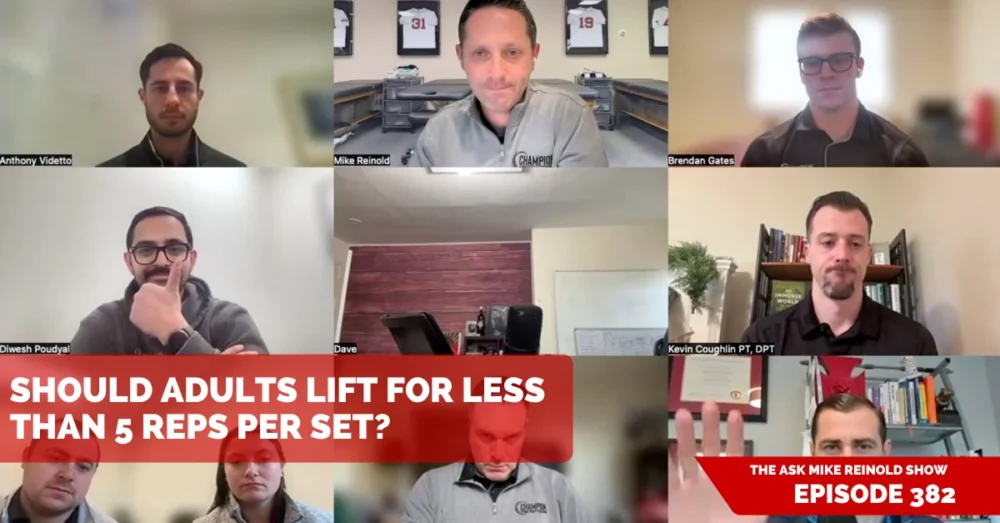
The dialogue evolved from a singular social media post into a broader industry-wide conversation, culminating in a detailed analysis by the team at Champion Physical Therapy and Performance, led by Dr. Mike Reinold.
- Phase One: The Social Media Spark. Boyle’s initial posts targeted the "ego-lifting" culture, suggesting that sets of 8–12 repetitions provide ample stimulus for hypertrophy and strength without the same level of joint stress as sets of 1–3 reps.
- Phase Two: The Industry Pushback. Trolls and critics argued that Boyle was "softening" the industry, claiming that avoiding heavy loads leads to suboptimal results in combating sarcopenia (muscle loss) and osteopenia (bone density loss).
- Phase Three: Clinical Synthesis. Dr. Mike Reinold and his staff at Champion—including sports performance directors and physical therapists—dedicated Episode 382 of the Ask Mike Reinold Show to dissecting these claims. They sought to bridge the gap between "hardcore" strength coaching and conservative physical therapy.
- Phase Four: The Shift Toward Nuance. The conversation has since shifted from a binary "good vs. bad" to a more nuanced "context-dependent" model, where age, training history, and specific goals dictate the rep scheme.
Scientific Context: Hypertrophy, Strength, and Tonnage
To understand the implications of this debate, one must look at the underlying physiology of resistance training. For decades, the "repetition continuum" suggested that strength was built at 1–5 reps, hypertrophy at 8–12 reps, and endurance at 15+ reps. However, contemporary research has challenged these rigid boundaries.
A landmark 2017 meta-analysis by Dr. Brad Schoenfeld demonstrated that muscle hypertrophy can be achieved across a wide range of repetition loads, provided the sets are taken close to failure. This supports the argument that adults do not need to lift ultra-heavy weights to maintain or grow muscle mass. Furthermore, the concept of "total tonnage"—the product of sets, repetitions, and weight—suggests that an adult can achieve a significant strength stimulus by increasing volume (sets and reps) rather than just intensity (weight on the bar).
For example, a trainee lifting 200 pounds for three sets of ten (6,000 lbs total tonnage) may receive a similar or superior physiological adaptation for general health compared to a trainee lifting 300 pounds for five sets of two (3,000 lbs total tonnage), with significantly less peak stress on the intervertebral discs and connective tissues.
The Champion Perspective: Risk-Reward and Workload Progression
At Champion Physical Therapy and Performance, the consensus largely aligns with Boyle’s conservative approach for the general adult population, but with specific caveats. Diwesh Poudyal, Director of Sports Performance at Champion, notes that many young coaches enter the field with a powerlifting bias. They often mistakenly apply the specialized goals of competitive lifters to 50-year-old clients whose primary objectives are playing with their grandchildren or hiking without pain.
"A heavy set of three or two is a very specialized goal," Poudyal stated during the discussion. "Unless someone comes in with that specific goal, I don’t think I need to be that specific in my training. We can focus on a baseline ability to produce force and be generally fit."
The team at Champion emphasizes the "Risk-Reward Ratio." For an adult with a history of lower back issues, the reward of a 400-pound deadlift for a single repetition is often eclipsed by the risk of a multi-week flare-up that halts all physical activity. The clinical perspective suggests that strength is "rented, not owned," and the most effective program is the one that the client can perform consistently for years without interruption.
Expert Reactions and Evolutionary Perspectives
The debate also highlights the personal evolution of coaches as they age. Dan Pope, a physical therapist and seasoned athlete, noted that his own training has shifted as he reached his 40s. While he once prioritized maximal loading, he now utilizes higher repetition ranges to manage the cumulative stress on his joints.
"As we age, our bodies don’t tend to handle as much stress as they once did," Pope explained. He suggested that while power (the ability to exert force quickly) is the first thing adults lose as they age, it can be trained through explosive movements with lighter weights—such as medicine ball throws or jumps—rather than relying solely on heavy, low-rep barbell lifts.
However, the team did identify specific use cases where low-repetition schemes remain appropriate for adults:
- Specific Performance Goals: Competitive powerlifters or masters-level athletes whose sport requires maximal force production.
- Endurance Athletes: Kevin Coughlin, a physical therapist at Champion, noted that runners often benefit from lower-volume, higher-intensity lifting. Because runners already handle high "tonnage" through their mileage, short, heavy lifting sessions can provide a neural stimulus without adding the excessive tissue damage associated with high-rep muscle-building sets.
- Late-Stage Rehabilitation: For patients returning from ACL reconstruction or other major surgeries, performing low-rep, high-effort sets can be necessary to restore "neural drive"—the brain’s ability to fully recruit a muscle group that has been dormant or inhibited.
Broader Implications for the Fitness Industry
This debate signals a maturing of the strength and conditioning profession. The industry is moving away from a "one size fits all" approach toward a "biopsychosocial" model that considers a client’s age, injury history, and psychological relationship with exercise.
Data from the Bureau of Labor Statistics and various fitness industry reports indicate that the "active aging" demographic is the fastest-growing segment of gym memberships. As the population ages, the demand for "longevity-based" programming is expected to rise. Coaches who insist on high-risk, low-rep schemes for every client may find themselves at odds with the growing body of clinical evidence favoring moderate-intensity, high-consistency models.
Furthermore, the discussion underscores the importance of "movement age" versus "chronological age." A 50-year-old who has been lifting consistently for 30 years has a different tissue tolerance than a 50-year-old beginning a program for the first time. The Mike Boyle/Mike Reinold consensus suggests that for the latter, low-rep sets are not only unnecessary but potentially irresponsible.
Analysis of Future Trends
As the dialogue continues, several trends are likely to emerge in adult fitness programming:
- The Rise of Tonnage over Intensity: More programs will focus on increasing total work capacity through moderate rep ranges (6–10) rather than chasing 1RM percentages.
- Increased Integration of PT and Strength Coaching: The "Champion model," which blends clinical physical therapy with performance coaching, is becoming the gold standard for managing the adult trainee.
- Power Training through Alternative Modalities: Instead of heavy triples in the squat, coaches will likely use plyometrics, sled pushes, and high-velocity movements with sub-maximal loads to combat the age-related decline in power.
Ultimately, the consensus among industry leaders like Boyle and Reinold is that "strength" should be defined by an individual’s ability to live a high-quality life, free from the limitations of injury. While the "internet trolls" may continue to argue for the necessity of the heavy single, the clinical and professional trend is firmly moving toward a more sustainable, rep-balanced future for the adult athlete.