The Northwest Territories (NWT) Teachers’ Conference recently served as a critical nexus for educational innovation and physical literacy, as Table Tennis North executed an expansive series of workshops designed to integrate high-performance athletics with classroom-ready wellness strategies. This multi-day engagement, held in Yellowknife, brought together educators from across the territory’s vast geographic landscape to explore how table tennis can serve as a versatile tool for student engagement, physical development, and community building. By bridging the gap between elite international competition and grassroots school programming, Table Tennis North aimed to provide teachers with a sustainable framework for introducing the sport to students in diverse and often remote Northern environments.
The presence of Ivy Liao, a prominent member of the Canadian National Table Tennis Team and a recognized ambassador for Aerobic Table Tennis, provided the event with a high level of technical expertise and inspirational value. Liao, who has represented Canada on the world stage and maintains a rigorous academic and athletic schedule at the University of British Columbia, transitioned from her role as a high-performance competitor to a pedagogical mentor for the duration of the conference. She was joined by Kathleen Cia, a standout athlete from Team NT, whose participation underscored the potential for Northern athletes to achieve regional success through dedicated training and mentorship. Together, the pair demonstrated that table tennis is not merely a recreational pastime but a sophisticated discipline capable of fostering significant cognitive and physical growth.
The Evolution of the NWT Teachers’ Conference as a Hub for Professional Development
The NWT Teachers’ Conference is a cornerstone event for the territorial education sector, providing a rare opportunity for educators from the Beaufort Delta, Sahtu, Dehcho, North Slave, and South Slave regions to convene. Given the logistical challenges of the North, where many communities are accessible only by air or seasonal ice roads, the conference serves as a vital platform for the exchange of ideas and the introduction of new curricula. The inclusion of Table Tennis North in this year’s agenda reflects a growing recognition of the importance of physical literacy in the holistic development of students.
Physical literacy, defined as the motivation, confidence, physical competence, knowledge, and understanding to value and take responsibility for engagement in physical activities for life, is a priority for the NWT Department of Education, Culture and Employment. By presenting table tennis as an accessible entry point for physical activity, Table Tennis North addressed several key educational objectives, including the development of fundamental movement skills and the promotion of mental well-being through inclusive play.
Aerobic Table Tennis: Merging Rhythm, Movement, and Inclusivity
A central highlight of the conference was the introduction of Aerobic Table Tennis, a specialized program championed by Ivy Liao. This methodology departs from traditional sport-specific training by incorporating music and rhythmic movement into the learning process. The goal of Aerobic Table Tennis is to lower the barrier to entry, making the sport appealing to individuals who may not identify as traditional athletes. By synchronizing movement with auditory cues, the program enhances cardiovascular health while simultaneously improving motor coordination.
During the workshops, Liao demonstrated how educators could utilize Aerobic Table Tennis to transform a standard gymnasium into a high-energy environment. For many teachers, the appeal of this program lies in its scalability. It requires minimal specialized equipment to start and can be adapted for students of varying abilities, including those with physical or cognitive disabilities. This focus on inclusivity is particularly relevant in the NWT, where classrooms are often composed of diverse learner profiles. The rhythmic nature of the exercises also provides a unique crossover with the arts and music curriculum, offering a multi-disciplinary approach to physical education.
Technical Training and the Community Coach Certification
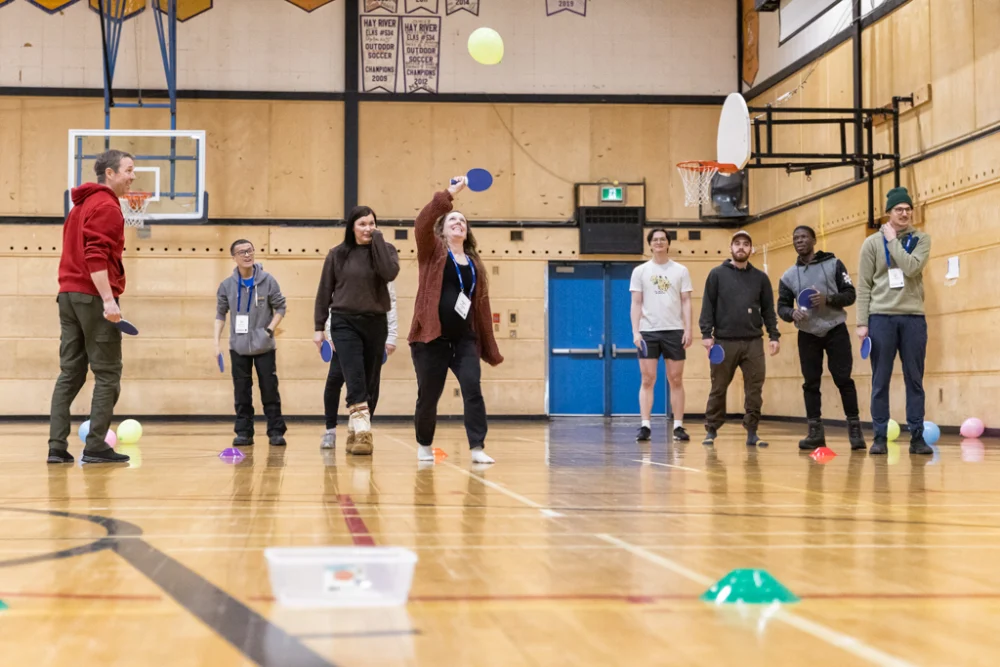
Beyond the high-energy aerobic sessions, Table Tennis North facilitated a structured Community Coach course. This segment of the conference was designed to provide teachers with formal credentials and a technical foundation in the sport. The coaching progression utilized a "scaffolded" learning model, beginning with basic coordination exercises using balloons rather than standard table tennis balls.
The use of balloons allowed participants to experience a slower rate of play, providing ample time to develop the hand-eye coordination necessary for the sport. This pedagogical technique is particularly effective for younger students or those new to racket sports, as it reduces frustration and builds immediate confidence. As the sessions progressed, the educators transitioned to using professional-grade paddles and celluloid balls, learning the fundamental mechanics of the grip, stance, and basic strokes such as the forehand and backhand drive.
The certification process ensures that when these educators return to their respective communities—whether in a small settlement like Colville Lake or a larger hub like Hay River—they possess the technical vocabulary and safety knowledge to lead their own school-based programs. This "train-the-trainer" model is essential for the long-term sustainability of the sport in the North, as it reduces the territory’s reliance on external experts and empowers local leaders.
Data and the Impact of Table Tennis on Student Cognitive Function
The promotion of table tennis in schools is supported by a growing body of neuroscientific research. Often referred to as "high-speed chess," table tennis requires rapid decision-making, spatial awareness, and acute focus. Studies have indicated that the sport stimulates several areas of the brain simultaneously, including the prefrontal cortex for strategic planning and the primary motor cortex for physical execution.
For students in the NWT, where long winters and limited daylight can impact mental health and sedentary behavior, table tennis offers a high-intensity indoor alternative that promotes "executive function"—the mental skills that include working memory, flexible thinking, and self-control. By bringing these facts to the attention of NWT educators, Table Tennis North emphasized that the sport is a tool for academic enhancement as much as it is for physical fitness. The ability to focus on a small, fast-moving object for extended periods has been shown to translate into improved concentration in classroom settings.
Strengthening the Northern Athlete Pipeline: Liao and Cia as Role Models
The collaboration between an international-level athlete like Ivy Liao and a territorial athlete like Kathleen Cia provided a powerful narrative for the conference. Liao’s journey from a young player in British Columbia to a National Team member serves as a blueprint for what is possible within the Canadian sport system. Her involvement in the NWT highlights Table Tennis Canada’s commitment to regional development and the importance of mentorship.
Kathleen Cia’s role was equally significant. As a representative of Team NT, she embodies the potential of Northern youth to excel when provided with the right resources and coaching. Her presence allowed teachers to see the tangible results of local investment in sport. For many educators, hearing the personal stories of these two athletes reinforced the idea that sports are a vehicle for personal growth, resilience, and discipline. The interaction between the high-performance athletes and the educators created a sense of shared purpose, focusing on how to identify and nurture talent within Northern schools.
Strategic Implications for Territorial Sport and Health
The success of Table Tennis North at the Teachers’ Conference has broader implications for the territorial government’s health and wellness mandates. The NWT has historically faced challenges related to chronic diseases and youth inactivity, often exacerbated by the high cost of equipment and travel for traditional sports like hockey or basketball. Table tennis, by contrast, is highly cost-effective. A single table can accommodate multiple players, and the equipment is durable and easily stored.
From a strategic standpoint, the integration of table tennis into the school system aligns with the "Sport for Life" Long-Term Athlete Development (LTAD) model. This model emphasizes that children should develop a wide range of movement skills before specializing in a single sport. Table tennis contributes to this by honing "physical literacy" components such as agility, balance, and coordination (ABCs), which are foundational to all physical activities.
Furthermore, the enthusiastic response from the educators suggests a high potential for the expansion of the territorial school championships. As more teachers become certified coaches, the quality of play at the grassroots level is expected to rise, eventually feeding into a more competitive and robust Team NT for the Arctic Winter Games and the Canada Winter Games.
Conclusion: A Foundation for Continued Growth
As the NWT Teachers’ Conference concluded, the impact of Table Tennis North’s involvement was evident in the newfound confidence of the participants. The gym floor, which had been a space of intense learning and rhythmic movement, served as a proving ground for a new era of school-based athletics in the North. The tools, techniques, and certifications acquired by the teachers represent a significant investment in the human capital of the NWT’s education system.
The partnership between Table Tennis North, national-level ambassadors like Ivy Liao, and local talents like Kathleen Cia demonstrates a successful model for sport promotion in remote regions. By focusing on movement, laughter, and inclusive ideas, the organization has ensured that the benefits of table tennis will ripple outward from Yellowknife to the furthest reaches of the territory. The ultimate beneficiaries of this initiative will be the students, who will now have access to a sport that challenges their bodies, engages their minds, and fosters a lifelong love of physical activity. Through the dedicated efforts of educators and the support of the sporting community, the Northwest Territories is well-positioned to become a leader in the integration of table tennis into the fabric of Northern life.