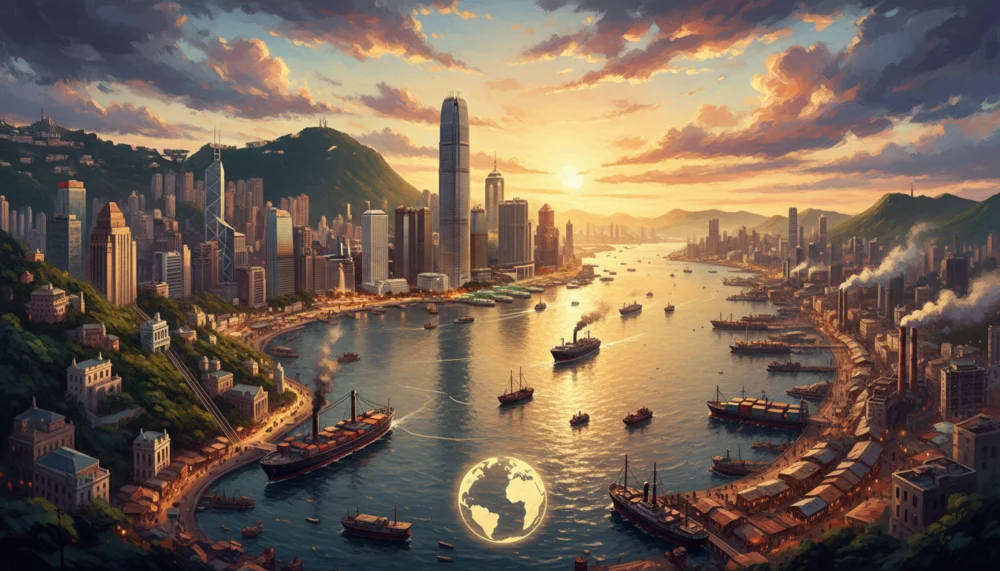
The Early Foundations: From Fishing Village to British Colony
Hong Kong’s journey toward international recognition began in the mid-19th century. Following the First Opium War, the Treaty of Nanking in 1842 officially ceded Hong Kong Island to the British Empire, marking its first formal entry into the global geopolitical stage.
Initially, the territory served primarily as a victualling station for British ships. However, its strategic location at the mouth of the Pearl River Delta quickly established it as a vital link between Western markets and the Qing Dynasty of China, attracting merchants from across the globe.
The Rise of the Entrepôt Trade
By the late 1800s, Hong Kong had transformed into a major entrepôt. It functioned as a duty-free port where goods from Europe and North America were stored and redistributed throughout East Asia, gaining the attention of international merchant houses and shipping firms.
This period saw the establishment of major financial institutions, such as the Hongkong and Shanghai Banking Corporation (HSBC) in 1865. This development solidified the territory’s reputation as a reliable hub for trade finance and currency exchange in the Far East.
The Post-War Industrial Explosion
While trade established its name, it was the post-World War II era that truly broadcast Hong Kong’s capabilities to the world. The 1950s saw a massive influx of capital and skilled labor from mainland China, particularly from the industrial city of Shanghai.
This migration fueled a rapid industrial revolution. Hong Kong began producing high-quality textiles, garments, and plastics that were exported globally, making the “Made in Hong Kong” label a household name in Western markets for the first time.
Diversification into Electronics and Toys
By the 1960s, the economy diversified further to meet global demand. Hong Kong became the world’s leading exporter of toys and a significant manufacturer of consumer electronics, proving its ability to adapt quickly to changing international market trends.
Emergence as a Global Financial Center
The 1970s marked a pivotal shift from manufacturing to services. The government’s policy of positive non-interventionism encouraged foreign investment and the growth of a robust stock market, attracting global banking giants to set up regional headquarters.
During this decade, Hong Kong was recognized as one of the Four Asian Tigers, alongside Singapore, South Korea, and Taiwan. This title cemented its status as a high-growth, industrialized economy with significant global influence.
Establishing the Rule of Law and Stability
The creation of the Independent Commission Against Corruption (ICAC) in 1974 was a landmark moment for international recognition. By cleaning up the public and private sectors, Hong Kong enhanced its international credibility as a transparent and safe place for global business.
Cultural Recognition: Cinema and Cuisine
International recognition was not limited to economics. The 1970s and 80s saw the global rise of Hong Kong Cinema. Martial arts icons like Bruce Lee became international superstars, bringing Hong Kong’s unique cultural identity to global screens.
- Action Movies: Hong Kong filmmakers revolutionized choreography and stunt work, influencing Hollywood and global cinema.
- Cuisine: Dim Sum and Cantonese flavors gained immense popularity, establishing Hong Kong as a world culinary capital.
- Skyline: The iconic Victoria Harbour skyline became a universal symbol of modern urban success and architectural innovation.
The 1997 Handover and Modern Identity
The 1984 Sino-British Joint Declaration and the subsequent 1997 Handover kept Hong Kong in the global spotlight. The “One Country, Two Systems” framework was a unique political experiment that the world watched with intense interest, further heightening its international profile.
Today, Hong Kong remains a critical international gateway. Its world-class infrastructure, including the Chek Lap Kok International Airport and the deep-water Victoria Harbour, ensures it remains a central node in global logistics, finance, and culture.