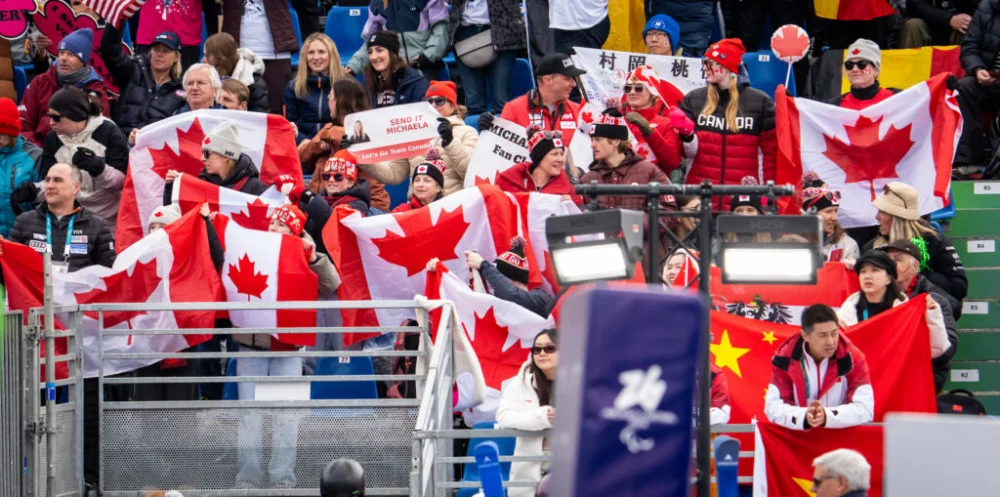
The sixth day of the Milano Cortina 2026 Paralympic Winter Games unfolded with a focused intensity for the Canadian delegation, characterized by a smaller competitive footprint but highlighted by a landmark achievement in the sport of wheelchair curling. While the medal count for the nation remained stationary on March 12, the day was defined by a historic performance at the curling rink and a display of consistency and emerging talent on the alpine slopes of Cortina d’Ampezzo. With only six athletes in active competition—four on the ice and two on the mountain—the Canadian Paralympic Team utilized the day to solidify its standing as a global powerhouse in winter parasports, setting the stage for what promises to be a high-stakes conclusion to the Games.
A Historic Milestone in Wheelchair Curling
The headline of the day belonged to the Canadian wheelchair curling quartet of Mark Ideson, Ina Forrest, Jon Thurston, and Collinda Joseph. In a sport where the margin for error is razor-thin and the level of international parity has increased significantly over the last decade, Canada achieved a feat never before seen in Paralympic history. By concluding their round-robin schedule with two decisive victories on Thursday, Canada became the first nation to ever navigate a Paralympic wheelchair curling round-robin tournament undefeated.
Entering the day with a 7-0 record, the Canadian squad faced a double-header that tested both their stamina and their tactical execution. In the afternoon session, Canada squared off against a disciplined South Korean team. The match was a strategic battle of positioning, with Canada eventually pulling away to secure a 6-3 victory. This win ensured they would finish at the top of the standings, but the team remained focused on maintaining their momentum heading into the evening draw against their North American rivals, the United States.
The evening matchup against the U.S. saw the Canadians maintain their clinical form. Despite the pressure of the historical milestone within reach, the team executed a 7-3 win, finalizing a perfect 9-0 record. This performance is particularly noteworthy given the evolution of the sport; wheelchair curling does not permit sweeping, meaning the accuracy of the initial delivery is paramount. To go undefeated across nine matches against the world’s elite suggests a level of technical precision and mental fortitude that sets a new benchmark for the sport.
Veteran Leadership and Tactical Resilience
The success of the curling program in Milano Cortina is built upon a foundation of immense experience. Ina Forrest, competing in her fifth Paralympic Winter Games, has been a cornerstone of the Canadian program since its early dominance. Reflecting on the 9-0 record, Forrest emphasized the difficulty of the achievement, noting that the field of competition has never been deeper. Her assessment highlights a key trend in the Paralympic movement: as more nations invest in para-programs, the "easy games" have effectively disappeared.
Skip Mark Ideson echoed these sentiments, providing insight into the team’s internal dynamics. Ideson noted that despite the perfect record, the week has been "long and grueling." He acknowledged that the team faced several "bad games" or difficult ends where they were outmaneuvered, but their ability to stick to established processes allowed them to recover. This resilience—the ability to make high-pressure shots when trailing or facing a cluttered house—has been the defining characteristic of the Canadian team this week.
The undefeated run places Canada as the heavy favorite heading into the semifinals on Friday. In a twist of scheduling, they are slated to face South Korea for the second time in 24 hours. While Canada holds the psychological advantage of the round-robin win, the knockout nature of the playoffs introduces a different set of pressures.
Para Alpine Skiing: Consistency and Youthful Ambition
While the curlers were making history in the city, the action on the slopes of Cortina d’Ampezzo focused on the women’s standing giant slalom. The Canadian Para alpine team, which has undergone a period of transition following the retirement of several legendary figures, showcased both its current stability and its future potential.
Michaela Gosselin, a two-time Paralympian, continued her impressive run of form by finishing eighth in the standing giant slalom. This result marks Gosselin’s fourth consecutive top-10 finish at these Games, a testament to her technical versatility across different disciplines. In the high-velocity world of para-alpine skiing, where course conditions can deteriorate rapidly between runs, Gosselin’s ability to maintain a high floor of performance is a significant asset for the Canadian team. Her eighth-place finish provides valuable points for the national standings and reinforces her position as a leader within the alpine squad.
The day also served as a major milestone for 18-year-old Florence Carrier, the youngest member of the entire Canadian Paralympic Team. Making her Paralympic debut, Carrier finished 13th in the giant slalom. For a teenager competing on the world’s biggest stage, the physical demands of the Cortina course were matched only by the psychological weight of the event. Carrier spoke candidly about battling nerves and the sensory overload of the Paralympic environment, including the noise of the crowds and the scale of the production. Her 13th-place finish is viewed by the coaching staff as a successful entry point into elite international competition, signaling that the developmental pipeline for Canadian para-alpine skiing remains robust.
Statistical Overview and Medal Standings
As of the conclusion of Day 6, Canada’s medal haul remains at 10, consisting of one gold, three silver, and six bronze medals. While no new hardware was added on March 12, the day was strategically productive.
Current Medal Tally (as of March 12, 2026):
- Gold: 1
- Silver: 3
- Bronze: 6
- Total: 10
The single gold medal was earned earlier in the Games in Para Nordic skiing, a discipline where Canada has historically excelled. The six bronze medals reflect a high frequency of "near-misses" and podium-adjacent finishes, suggesting that the team is competitive across a wide spectrum of events. Analysts suggest that the high number of bronze and silver medals indicates a team with significant depth, even if they have struggled to convert that depth into gold in the first half of the Games. However, with the curling playoffs and several high-probability Para Nordic and Para Snowboard events remaining, the potential for an upward shift in the gold medal count remains high.
Comparative Analysis: Milano Cortina vs. Previous Games
To understand the significance of the current 10-medal total, it is helpful to compare Canada’s trajectory with previous Winter Paralympics. In Beijing 2022, Canada finished with 25 medals (8 gold, 6 silver, 11 bronze). At the same six-day mark in PyeongChang 2018, the count was similar to the current pace, often accelerating in the final three days as the team-sport medals (Curling and Para Hockey) and the long-distance Nordic events are decided.
The 9-0 record in curling is statistically superior to any previous Canadian performance at this stage. Even during the gold-medal runs of 2006, 2010, and 2014, the Canadian team typically dropped at least one or two games in the round-robin. The 2026 performance suggests a tactical evolution in how the team manages the "power-play" and the placement of the stationary stones, a testament to the coaching staff’s preparation leading up to the Italian Games.
Broader Implications for the Canadian Paralympic Movement
The results from Day 6 reflect a broader strategy by the Canadian Paralympic Committee (CPC) to balance veteran expertise with youth development. The contrast between Ina Forrest (a 5-time Paralympian) and Florence Carrier (an 18-year-old debutant) encapsulates the current state of the movement. Canada is successfully transitioning its roster, ensuring that the institutional knowledge of legends like Forrest and Ideson is passed down to the next generation of athletes.
Furthermore, the historical performance in curling reinforces Canada’s cultural identity as a "curling nation." The ability to adapt the traditional game to the wheelchair discipline—and to do so with such dominance—serves as a powerful narrative for disability sports in Canada. It highlights the accessibility of the sport and the high level of professional support provided to para-athletes through the Own the Podium program and national sporting organizations.
Looking Ahead: The Final Push
As the Games move into the penultimate weekend, the focus for the Canadian team shifts from accumulation to conversion. The curling semifinals on Friday represent a critical junction. A win against South Korea would guarantee at least a silver medal and put Canada in a position to reclaim the gold they last won in 2014.
In alpine skiing, the technical events will continue, with Gosselin looking to break into the top five and Carrier aiming to build on her debut experience. Additionally, the Para Nordic team, which had a rest day for many of its top performers on Thursday, will return to the trails for the relay and long-distance events, where Canada is expected to be a primary medal contender.
The "quiet" nature of Day 6 was, in reality, the calm before the storm. By securing a historic standing in curling and blooding new talent on the ski slopes, Canada has positioned itself for a potentially record-breaking finish to the Milano Cortina 2026 Paralympic Winter Games. The focus now turns to the ice at the Milano Curling Center, where four athletes look to turn a perfect record into Paralympic gold.