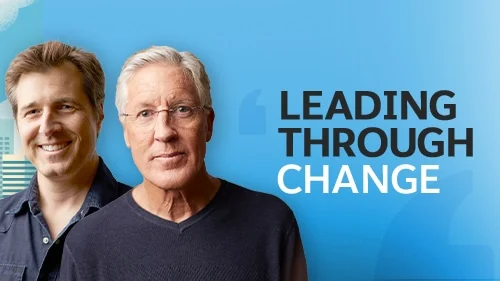
On July 21, 2020, amid a global landscape defined by unprecedented professional and personal volatility, Seattle Seahawks head coach Pete Carroll and world-renowned high-performance psychologist Dr. Michael Gervais joined Salesforce’s "Leading Through Change" podcast to discuss the intersection of elite sports psychology and corporate leadership. Hosted by Lynne Zaledonis, Salesforce’s Senior Vice President of Product Marketing, the conversation provided a roadmap for navigating the physical and mental challenges of the COVID-19 pandemic. The dialogue centered on the "Compete to Create" philosophy, a coaching framework developed by Carroll and Gervais that posits that the mental disciplines required to win a Super Bowl are the same tools necessary for excellence in the boardroom and daily life. This discussion arrived at a critical juncture for the global workforce, as organizations grappled with remote work transitions, economic uncertainty, and a burgeoning mental health crisis among employees.
The Genesis of a High-Performance Partnership
The collaboration between Pete Carroll and Dr. Michael Gervais began in 2012, a pivotal year for the Seattle Seahawks. Carroll, who had taken the helm of the franchise in 2010, was in the process of implementing a radical culture based on "competitive greatness" and the celebration of individual authenticity. To validate and expand this culture, he invited Gervais to the team’s training camp to observe the environment firsthand. Gervais, who had spent years working with Olympic athletes and extreme sports icons like Felix Baumgartner, described the Seahawks’ camp as a unique ecosystem where "one hundred alpha competitors" were unified by a singular vision.
This encounter led to the formalization of their shared philosophies into "Compete to Create," a training platform designed to bring high-performance psychology to the masses. The partnership was built on the realization that while elite athletes spend 90% of their time training for a 10% performance window, corporate professionals often spend 100% of their time performing with 0% of their time dedicated to mental training. The transition of these methodologies from the "amphitheater of high stakes" in the NFL to the corporate enterprise was driven by the belief that living with purpose requires a structured approach to the mind, just as physical fitness requires a structured approach to the body.
The Triad of Training: Craft, Body, and Mind
A core tenet of the Carroll-Gervais philosophy is the "Triad of Training." According to Dr. Gervais, there are only three variables an individual can truly influence: their craft, their body, and their mind. While most professional development programs focus exclusively on "craft"—the technical skills required for a job—and wellness programs focus on the "body," the "mind" is often left to chance.
During the Salesforce broadcast, Gervais emphasized that confidence is not a fixed trait but a skill that can be developed through rigorous practice. He introduced the concept of "Tier Zero" for change, which he identified as mindfulness. In this context, mindfulness is defined as the ability to sustain awareness of one’s thoughts, words, and actions in real-time. By mastering this awareness, individuals can align their behavior with their personal philosophy, ensuring that they remain grounded even when external circumstances are chaotic. This internal alignment is what Carroll refers to as finding one’s "center."
Strategic Optimism and the Power of Personal Philosophy
Pete Carroll’s coaching success—which includes a Super Bowl championship and multiple division titles—is frequently attributed to his unrelenting optimism. However, during the "Leading Through Change" episode, Carroll clarified that his optimism is a tactical choice rather than a mere personality trait. He argued that an optimistic outlook allows a leader to operate as if "something good is just about to happen," which in turn fosters an environment of psychological safety and high performance.
Carroll highlighted the necessity of a "personal philosophy" for every leader and employee. He recounted his own journey of self-discovery, noting that he needed to become "clear on who I am" so that those around him could act with clarity and conviction. In a corporate setting, this translates to being a "great teammate" by being in service of others. Carroll’s approach challenges the traditional top-down corporate hierarchy, suggesting instead that leadership is about helping individuals uncover their unique qualities and championing them to benefit the collective.
Navigating the 2020 Crisis: Data and Contextual Implications
The timing of this discussion was significant. In July 2020, data from the Centers for Disease Control and Prevention (CDC) indicated that approximately 40% of U.S. adults were struggling with mental health or substance use issues related to the pandemic. Furthermore, a Salesforce study conducted during the same period revealed that nearly 60% of employees felt that their mental health had a direct impact on their productivity.
The Carroll-Gervais framework addressed these statistics by emphasizing the "science and art of recovery." Gervais noted that in high-stakes environments, the ability to recover—both mentally and physically—is what allows for sustained excellence. For the remote worker, this might mean setting strict boundaries between work and home life or engaging in "micro-recoveries" throughout the day to prevent burnout. The goal, as Gervais stated, is for individuals to wake up with "zest and zeal" consistently, rather than operating in a state of perpetual exhaustion.
The Role of Technology in Scaling Resilience
A significant portion of the conversation focused on how technology, specifically Salesforce’s platform, has enabled "Compete to Create" to scale its insights. In a traditional coaching model, the reach of a psychologist or a head coach is limited to the individuals in the room. By leveraging digital tools, Carroll and Gervais have been able to provide enterprise-wide training to thousands of employees simultaneously.
Salesforce’s "Leading Through Change" series itself serves as a case study for this digital transformation. By providing a platform for leaders from diverse fields—sports, business, and healthcare—to share actionable insights, the series aimed to create a "community of learning" during a time of physical isolation. The integration of high-performance psychology into business software ecosystems suggests a future where professional development is as much about emotional intelligence and mental resilience as it is about data analytics or sales figures.
Analysis of Implications: From the Field to the Boardroom
The implications of the Carroll-Gervais philosophy extend beyond the immediate crisis of 2020. Their approach signals a shift in corporate culture toward a more holistic view of the employee. When Carroll speaks about "coaching individuals within a relationship-based organization," he is advocating for a move away from transactional management.
From a journalistic perspective, the success of "Compete to Create" within organizations like Salesforce and Microsoft suggests that the "alpha competitor" model is being redefined. In the 20th century, corporate competition was often viewed through a lens of zero-sum aggression. In the 21st century, as articulated by Carroll, competition is about "striving to be your best" in a way that elevates those around you. This "service-based" leadership model is increasingly seen as a requirement for attracting and retaining talent in a workforce that prioritizes purpose and mental well-being.
Chronology of High Performance Integration
To understand the impact of this discussion, one must look at the timeline of Carroll and Gervais’s influence on the broader culture:
- 2010: Pete Carroll joins the Seattle Seahawks, bringing a philosophy of "Always Compete."
- 2012: Dr. Michael Gervais joins the Seahawks’ camp; the "Compete to Create" framework begins to take shape.
- 2014: The Seahawks win Super Bowl XLVIII, providing a global proof-of-concept for their mental training methods.
- 2018: Compete to Create expands its corporate offerings, partnering with major tech firms to deliver digital coaching.
- March 2020: The global pandemic forces a massive shift to remote work, creating an urgent demand for mental resilience tools.
- July 2020: The Salesforce "Leading Through Change" episode brings these elite strategies to a global business audience, emphasizing the necessity of a "personal philosophy" in times of upheaval.
Conclusion: The Enduring Need for Mindset Training
The conversation between Pete Carroll, Dr. Michael Gervais, and Lynne Zaledonis underscored a fundamental truth of the modern era: the mind is the ultimate frontier of performance. Whether facing a goal-line stand in the Super Bowl or a quarterly earnings call during a pandemic, the psychological requirements for success remain constant. By discipline themselves to return to their "center" and viewing successes and defeats as equally challenging opportunities for growth, leaders can maintain the stability required to navigate any crisis.
As the corporate world continues to evolve, the lessons from "Leading Through Change" remain relevant. The integration of mindfulness, optimism, and structured mental recovery into the workplace is no longer a luxury but a strategic necessity. In the words of Pete Carroll, the goal is to be "available for the wins," a state of readiness that can only be achieved through the deliberate and consistent training of the mind.