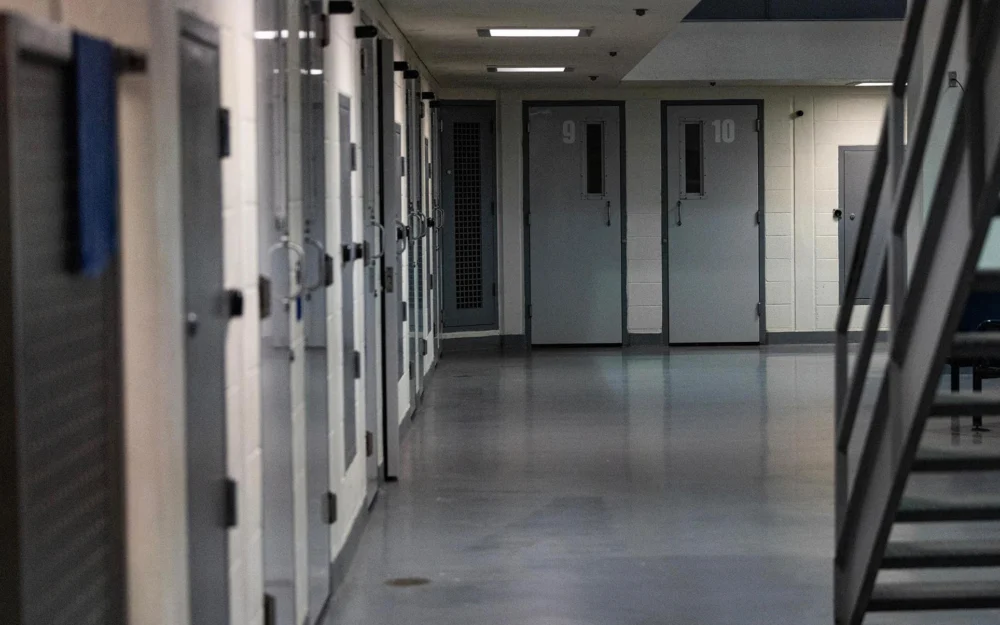
The detention of 26-year-old Shawn Fraraccio in the Tarrant County Jail has entered its second year, sparking an intense debate over the treatment of individuals with intellectual and developmental disabilities (IDD) within the Texas criminal justice system. Fraraccio, who functions at the cognitive level of a child between six and eight years old, has been held since December 2024 on charges of continuous violence against a family member. His mother, Christy Bridgman, who is the named victim in the case, has become his most vocal advocate, pleading for his release as his physical and mental health reportedly deteriorate in a single-cell environment.
The case highlights a systemic bottleneck in the Texas judicial and healthcare systems, where defendants deemed incompetent to stand trial are frequently "warehoused" in county jails for months or years while awaiting placement in state-run treatment facilities. As Fraraccio’s time behind bars extends with no clear end date, the intersection of public safety, defendant rights, and the availability of state resources has come under renewed scrutiny from advocates and local officials alike.
A Chronology of the Case and Legal Proceedings
The legal trajectory of Shawn Fraraccio began in December 2024, when he was arrested twice following domestic altercations at his mother’s residence in Azle, Texas. According to court records, the first arrest occurred after a neighbor reported a disturbance to the police. The second incident took place while Bridgman was on a call with a representative from My Health My Resources (MHMR) of Tarrant County, a state-contracted nonprofit providing mental health and disability services. The MHMR representative, concerned by the sounds of the altercation, alerted law enforcement.
In March 2025, a Tarrant County grand jury indicted Fraraccio. However, the legal process reached a standstill in May 2025, when a mental health magistrate officially found Fraraccio incompetent to stand trial. Under Texas law, when a defendant is found incompetent, the court typically orders "competency restoration," a process intended to educate the defendant on legal proceedings so they can participate in their own defense.
For individuals with intellectual disabilities, this restoration often takes place in a State Supported Living Center (SSLC). Consequently, Fraraccio was ordered to remain in the Tarrant County Jail without bond until a bed becomes available at one of these specialized state facilities. Despite the mother filing an affidavit of non-prosecution—a formal request for the District Attorney to drop the charges—the case remains active. The District Attorney’s Office has maintained that the charges are necessary to ensure the safety of both the victim and the community, leaving Fraraccio in a state of legal and medical limbo.
Physical Decline and the Realities of Incarceration
Christy Bridgman’s descriptions of her son’s current state stand in stark contrast to the jail’s official reports. Before his incarceration, Fraraccio weighed over 200 pounds and required constant assistance with basic hygiene, including bathing and dental care. During recent visits, Bridgman reported that her son appeared "skeletal," unshaven, and disheveled. She expressed grave concerns regarding self-inflicted injuries, noting that Fraraccio has been observed banging his head against the walls of his cell—a behavior often associated with extreme distress in individuals with IDD.
"He looks like he’s dying," Bridgman told the Star-Telegram. "He’s meat and bones."
The Tarrant County Sheriff’s Office has defended its management of Fraraccio’s care, asserting that he is housed in the jail’s infirmary near a nurse’s station to ensure frequent monitoring. A spokesperson for the office stated that Fraraccio is provided with a "more comfortable mattress" and is permitted to change his clothes three times per week, exceeding the standard once-a-week policy for general population inmates. Additionally, the jail conducts safety checks every 20 minutes, which surpasses the state’s minimum requirement of 30-minute intervals for high-risk inmates.
Regarding his physical health, the Sheriff’s Office noted that Fraraccio has access to liquid nutritional supplements to maintain his caloric intake. However, Bridgman remains skeptical, alleging that her son is not receiving his prescribed seizure medication consistently and is incapable of requesting the help or supplements he needs due to his limited cognitive abilities.
The SSLC Crisis: A Statewide Bottleneck
The primary reason for Fraraccio’s prolonged stay in jail is the severe shortage of beds in Texas State Supported Living Centers. Susan Garnett, CEO of MHMR Tarrant County, explained that while her organization provides services within the jail, they have no authority over the transfer process to state facilities. That power resides solely with the Texas Health and Human Services Commission (HHSC).
Texas currently operates 13 SSLCs, which provide 24-hour residential care for people with intellectual and developmental disabilities. However, these facilities serve a total of only approximately 2,700 residents statewide. Only a small fraction of these are designated as "forensic beds," reserved for individuals entangled in the criminal justice system.
The waitlist for these beds has become a chronic crisis in Texas. In many instances, defendants wait more than a year for a transfer. During this period, the "restoration" process cannot begin, and the criminal case cannot move forward. This creates a "catch-22" for individuals like Fraraccio: they cannot be tried because they are incompetent, but they cannot be released because they are considered a safety risk, and they cannot be treated because there is no room in the appropriate facilities.
Furthermore, advocates point out a fundamental flaw in the "competency restoration" model for individuals with IDD. Unlike mental illness, which can often be managed or stabilized with medication, an intellectual disability is a permanent developmental condition. Critics argue that attempting to "restore" someone with a cognitive age of six to legal competency is often an exercise in futility that results in indefinite detention without a conviction.
Data and Comparative Safety in North Texas Jails
The concerns raised by Fraraccio’s family are amplified by the recent history of the Tarrant County Jail. Since Sheriff Bill Waybourn took office in 2017, more than 70 inmates have died while in custody. These deaths have resulted from various causes, including natural illnesses, suicides, and, in some high-profile cases, the use of force by jail staff. The death of Anthony Johnson, which was ruled a homicide, remains a point of significant contention and public outcry regarding jail oversight.
In its defense, the Tarrant County Sheriff’s Office has provided comparative data to suggest that its mortality rates are lower than those of other major Texas metropolitan areas. From 2017 through 2025, records show:
- Harris County: 140 deaths
- Bexar County: 109 deaths
- Dallas County: 77 deaths
- Tarrant County: 70+ deaths
While the Sheriff’s Office uses these figures to argue that Tarrant County is performing better than its peers, civil rights groups and families of the deceased argue that any death in a county jail—where many inmates are awaiting trial and have not been convicted of a crime—is a failure of the system. For a population as vulnerable as those with IDD, the risks of the jail environment are exponentially higher.
Official Responses and Public Appeals
The Tarrant County District Attorney’s Office has remained firm in its decision to pursue the case despite Bridgman’s affidavit of non-prosecution. A spokesperson for the office emphasized that the goal is community safety and that the defendant requires the "proper care" found in an SSLC. "Our concern is for the safety of his mother, his safety and the safety of the community in general," the office stated.
However, on March 10, Bridgman took her plea to the Tarrant County Commissioners Court, seeking a way to expedite her son’s transfer or secure his release into a private care setting. She warned the commissioners that if action is not taken, her son could become another statistic in the list of in-custody deaths.
Susan Garnett of MHMR noted that Fraraccio is not alone; there are likely five or six other inmates in Tarrant County in nearly identical situations—stuck between a jail cell and a full state facility. She described the situation as "heartbreaking," noting that the legal system often fails to account for the actual cognitive capacity of the individuals it processes.
Implications for Policy and Disability Rights
The case of Shawn Fraraccio serves as a stark illustration of the "decriminalization of disability" movement’s primary hurdles. When social services and state-funded healthcare facilities are underfunded or over capacity, the county jail becomes the "de facto" mental health and IDD facility of last resort.
Legal experts suggest that several policy shifts could address these issues, including:
- Increased Funding for Forensic Beds: Expanding the capacity of SSLCs specifically for those in the justice system.
- Diversion Programs: Strengthening the ability of prosecutors to divert IDD individuals into community-based treatment or private residential care rather than seeking traditional prosecution.
- Competency Legislation Reform: Reevaluating the "competency restoration" requirement for individuals whose disabilities are permanent and developmental, potentially allowing for alternative legal resolutions that do not require indefinite detention.
As it stands, Shawn Fraraccio remains in a single cell in Fort Worth, a man with the mind of a child caught in a system designed for adults. His mother continues to wait for a response from the District Attorney, fearing that the "proper care" the state promises will arrive only after it is too late. The outcome of this case may well serve as a bellwether for how Tarrant County and the State of Texas choose to balance the scales of justice and mercy for its most vulnerable citizens.