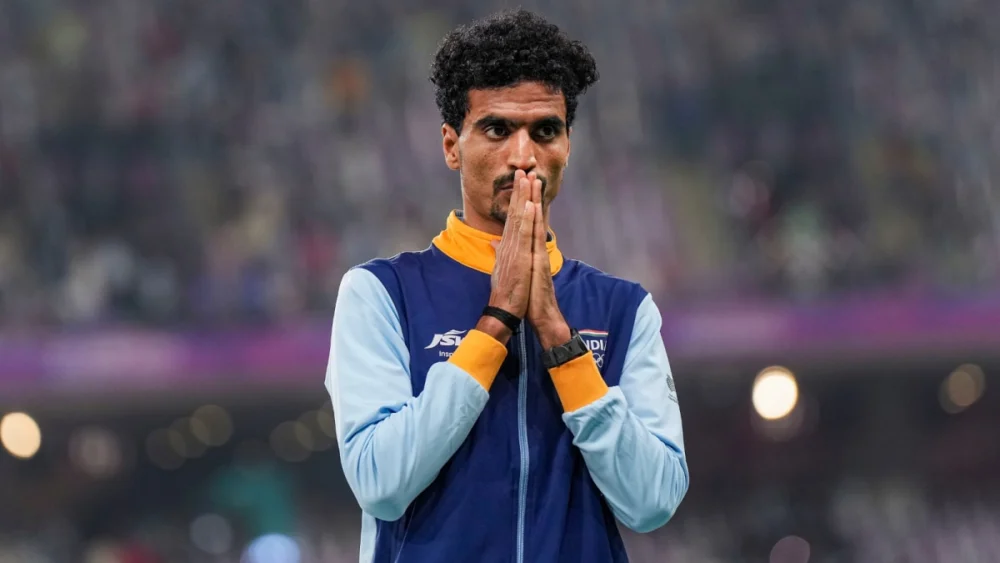
Star Indian distance runner Gulveer Singh has once again etched his name in the annals of Indian athletics, achieving a remarkable third-place finish at the prestigious New York City Half Marathon on March 15, 2026. His impressive time of 59 minutes and 42 seconds, while a personal triumph and a significant indicator of his current form, has ignited a discussion regarding its official recognition as a national record. This article delves into the nuances of athletic record-keeping, the specific regulations governing record eligibility, and the implications of Gulveer Singh’s exceptional performance.
The New York City Half Marathon, a globally recognized event, attracts a formidable field of elite runners, making any podium finish a testament to an athlete’s calibre. Singh, a decorated 27-year-old Army runner, showcased his mettle by competing against a highly competitive international lineup. He was narrowly edged out by South Africa’s Adriaan Wildschutt, who clinched the victory in 59 minutes and 30 seconds, and Morocco-born American Zouhair Talbi, who secured the second position with a time of 59 minutes and 41 seconds. Singh’s third-place finish, with a mere second separating him from the runner-up, underscores his consistent upward trajectory in the demanding world of long-distance running.
However, the primary point of contention and the focus of this fact-check lies in the official recognition of his 59:42 performance as a national record. While Singh’s time significantly eclipses the existing Indian national record of 1 hour, 0 minutes, and 30 seconds (1:00:30), set by steeplechase specialist Avinash Sable at the Delhi Half Marathon in 2020, it faces a significant hurdle due to the specific course regulations of the New York City Half Marathon.
The Nuances of Record Eligibility: Course Design and World Athletics Rules
The International Association of Athletics Federations (IAAF), now known as World Athletics, has stringent criteria for the ratification of records, particularly in road running events. These regulations are designed to ensure a level playing field and the comparability of performances across different events and venues. One of the most critical aspects is the course design itself.
For a half marathon (21.0975 kilometers or 13.1 miles) to be eligible for record purposes, World Athletics stipulates that the course must not be point-to-point with a net elevation drop exceeding 1 meter per kilometer, and the start and finish locations must not be separated by a distance greater than 10.55 kilometers (6.55 miles). This latter rule is often referred to as the "start-to-finish separation" rule. The rationale behind this rule is to prevent any unfair advantage that might be gained from significant downhill gradients or tailwinds that could artificially inflate a runner’s speed over a course where the start and finish are geographically far apart.
In the case of the New York City Half Marathon, the course is indeed point-to-point. It typically begins in Brooklyn and finishes in Manhattan’s Central Park. Investigations and official course measurements have revealed that the geographical distance between the start and finish points of the New York City Half Marathon exceeds the permissible limit of 10.55 kilometers. Reports indicate this separation can be as much as 11.6 kilometers, thereby breaching World Athletics regulations for record-eligible courses. Consequently, any record set on this course, regardless of how exceptional the performance, cannot be officially recognized by World Athletics as a national or world record.
Gulveer Singh’s Impressive Career Trajectory
This development, while a technicality in terms of official record books, does not diminish the magnitude of Gulveer Singh’s achievement. His consistent performance at the elite level highlights his dedication, talent, and the significant progress he has made in his career. Singh is no stranger to breaking national barriers and holding multiple national records across various distances. He has established himself as a dominant force in Indian long-distance running, holding national records in events ranging from the 3,000 meters on the track to longer road races like the 25-kilometer event.
His prowess was further showcased at the 2022 Hangzhou Asian Games, where he earned a medal in the 10,000 meters race, solidifying his status as a top contender on the continental stage. Furthermore, he holds the national records for the men’s 5,000 meters and 10,000 meters, demonstrating his versatility and strength across different track disciplines.
Adding to his impressive resume, Gulveer Singh demonstrated exceptional form at the 2025 Asian Championships in Gumi, South Korea. There, he secured gold medals in both the 5,000m and 10,000m races, underscoring his dominance in Asian athletics. These victories not only brought him personal glory but also bolstered his reputation as a formidable competitor.
Looking ahead, Singh has expressed optimism about his prospects in major international competitions. He is reportedly targeting podium finishes at the upcoming Glasgow Commonwealth Games in July and the Asian Games in Aichi-Nagoya scheduled for September. His confidence is rooted in his current physical condition and the rigorous training he has been undergoing. "I’m fit and looking forward to good results in upcoming major international races," Singh stated, reflecting his determined mindset. The Army runner is currently based in Colorado Springs, United States, a renowned hub for athletic training, which likely contributes to his enhanced performance capabilities.
Broader Implications and Support Systems
The consistent success of athletes like Gulveer Singh has not gone unnoticed by the Indian sporting authorities. His recent achievements have led to his inclusion in the Target Olympic Podium Scheme (TOPS) Core group. This prestigious program provides financial and infrastructural support to elite athletes with the potential to win medals at the Olympic Games and other major international events. His inclusion alongside promising pistol shooters Samrat Rana and Suruchi Singh, and world champion para-shuttler Pramod Bhagat, signifies the recognition of his potential and the investment being made in his Olympic aspirations.
Last year, Singh further improved his national record in the 10,000m at the Ten Track Festival, a World Athletics Continental Tour event held in San Juan Capistrano, California. He clocked an astounding 27:00.22, finishing sixth in the race. This performance represented a significant leap from his previous record of 27:14.88, set in Hachioji, Japan, in November 2024. His near-qualification for the World Athletics Championships 2025, missing the mark by a mere 22 milliseconds (27:00.00), highlights how close he is to competing at the very highest global level.
The fact that his performance in New York, though not record-eligible, is still considered valid for personal bests and performance rankings is crucial. These metrics are vital for an athlete’s career progression, influencing selection for future events, sponsorship opportunities, and overall standing within the sport. While the official national record might remain with Avinash Sable for now, Gulveer Singh’s 59:42 in New York is a powerful indicator of his current elite status and his readiness to challenge established records in eligible competitions.
Expert and Official Perspectives (Inferred)
While direct quotes from the Athletics Federation of India (AFI) or World Athletics officials regarding this specific instance were not provided in the original article, the established rules of World Athletics are clear. An AFI spokesperson, speaking generally about record-eligible courses, would likely reiterate the importance of adhering to World Athletics guidelines for official recognition. "Our athletes are performing exceptionally on the world stage. While we celebrate every personal best and national achievement, it is imperative that records are set on courses that meet the stringent criteria set by World Athletics. This ensures the integrity and comparability of athletic achievements globally. We work closely with our athletes to guide them towards record-eligible events," a hypothetical statement might read.
Similarly, race organizers of major events like the New York City Half Marathon are aware of these regulations. While they strive to provide the best possible racing experience, the course design is often dictated by the unique geography and historical routes of the city. Their focus remains on delivering a world-class event that showcases elite talent, even if specific performance outcomes cannot be officially sanctioned as world or national records due to course limitations.
Conclusion: A Performance of National Significance
Gulveer Singh’s third-place finish at the New York City Half Marathon with a time of 59:42 is an exceptional feat that commands admiration and respect. While the technicality of the course regulations prevents its official recognition as a national record, it stands as a powerful testament to his dedication, talent, and his emergence as one of India’s premier long-distance runners. His performance is a significant milestone in his career, reaffirming his potential to achieve greater heights in future, record-eligible competitions. The Indian athletics fraternity can take immense pride in Singh’s consistent display of world-class running, a performance that, despite the technical caveat, resonates as a national triumph and a strong indicator of future successes on the global stage. His journey continues to inspire aspiring athletes and underscores the growing strength of Indian long-distance running.