The Scope and Methodology of the Longitudinal Analysis
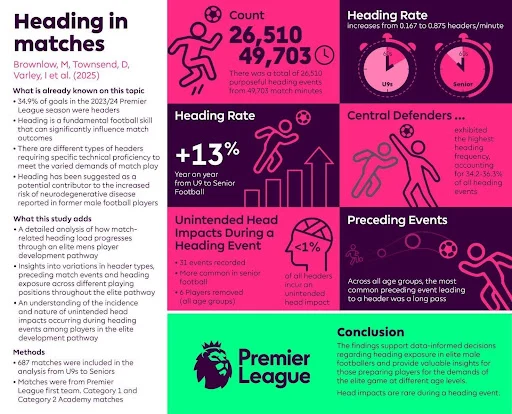
The research was designed as a prospective observational cohort study, representing one of the most extensive video-based analyses of footballing mechanics ever conducted within the English professional system. Between April 2021 and June 2024, trained analysts scrutinized 687 matches across the entire spectrum of the elite player pathway. This included Category One and Two Academies, which represent the highest tier of youth development in England, and extended to First Team matches within the Premier League. The timeline of the study is particularly significant, as it captures the game during a period of heightened awareness regarding player safety and the implementation of new training guidelines aimed at limiting high-force headers in practice.
To ensure the highest level of data integrity, the research team employed a rigorous coding system. Every "purposeful heading event"—defined as an intentional, direct impact between the head and the ball—was recorded. Beyond the mere frequency of these events, analysts also documented the "preceding match action," such as long passes, clearances, crosses, or set pieces. Furthermore, the study meticulously tracked "unintended head impacts," which occur when a player’s head makes contact with an opponent’s head, arm, or the ground during a heading attempt. These unintended impacts are often cited by medical professionals as the primary catalysts for acute concussive injuries. By utilizing negative binomial regression for their comparative analysis, the researchers were able to account for the inherent variability in match dynamics, providing a statistically robust view of heading density per minute of play.
Progressions in Exposure: The 13 Percent Annual Escalation
One of the most striking findings of the study is the linear and predictable nature of heading exposure as players age. The data reveals that heading frequency increases by an average of 13% with each subsequent age group. In the Foundation Phase, which encompasses Under-9 to Under-11 levels, heading is a relatively rare occurrence. At the Under-9 level, the rate was recorded at a mean of 0.167 headers per minute of match play. However, by the time players reach the First Team level, this rate climbs to 0.895 headers per minute.
This five-fold increase between the start of the academy journey and professional adulthood highlights a significant shift in the technical demands of the sport. The transition from the Foundation Phase to the Youth Development Phase (U12–U16) and subsequently the Professional Development Phase (U18–U21) represents a period of rapid escalation. For performance staff and coaches, this data is invaluable for "load management." It suggests that players transitioning between age groups, or those "playing up" in older categories, face a sudden and measurable increase in physical demands that must be managed to prevent both musculoskeletal and neurological strain.
The Influence of Tactical Positioning on Physical Demands
The study confirms that a player’s role on the pitch is the single greatest determinant of their heading exposure. Central defenders (center-backs) consistently recorded the highest heading frequencies across every age group and development phase. In the modern tactical landscape, central defenders are tasked with winning aerial duels from long goal kicks, clearing crosses from wide areas, and acting as the primary targets or defenders during set pieces.
In contrast, wide attackers and central attackers recorded the lowest frequency of heading events. This disparity underscores the necessity for position-specific training and medical monitoring. While a central defender may require specific neck-strengthening exercises and technical coaching to handle high-velocity impacts, a winger may focus more on the rare but often high-stakes headers involved in attacking crosses. The data suggests that a "one-size-fits-all" approach to heading guidelines may overlook the vastly different realities faced by players based on their positions.
Tactical Evolution and the Physics of Impact
The context in which headers occur also undergoes a profound transformation as players mature. Across all age groups, the "long pass" remains the most common precursor to a header, followed by clearances and throw-ins. However, the study observed a notable shift in set-piece dynamics. At the Under-9 level, more than half (51%) of all set-play headers followed a throw-in. This is likely due to the limited physical strength of younger players, who struggle to deliver long, high-velocity corners or free kicks.
As players reach the Under-12 level, the proportion of headers from throw-ins drops to approximately 31%, while headers from free kicks more than double, rising from 8% to 18%. This shift coincides with the players’ developing physical capability to strike the ball with greater power over longer distances. This evolution has significant implications for player safety: long passes and clearances are associated with higher ball speeds and, consequently, higher impact forces. The study suggests that the lower-speed headers typical of the Foundation Phase (such as those from throw-ins) may serve as a natural "on-ramp," allowing young players to develop essential ball-tracking and timing skills before they are exposed to the more violent forces of the professional game.
Safety Metrics: Unintended Impacts and Concussion Risk
Amid growing concerns regarding the safety of heading, the study provides a reassuring perspective on the frequency of accidental collisions. Unintended head impacts—such as head-to-head or head-to-elbow contact—were found to be remarkably rare, occurring in less than 1% of all purposeful heading events (31 instances out of 26,510 recorded headers). Of these instances, only six players required removal from play following a medical assessment.
The incidence of these unintended impacts was highest in First Team matches and lowest in the Foundation Phase. This increase in risk at the professional level can be attributed to the greater speed of the game, the increased physical size and strength of the athletes, and the higher stakes of competitive play, which often lead to more aggressive aerial challenges. While the low percentage of accidental impacts is positive, the study emphasizes that because these events are the most likely to result in concussions, they remains a critical focal point for officiating and medical protocols.
Broader Implications for the Future of Football
The findings of this study arrive at a pivotal moment for football’s governing bodies, including the Football Association (FA) and the Premier League. For years, the sport has grappled with how to balance the preservation of its traditional mechanics with the mounting evidence of the risks associated with repetitive head impacts. By providing a detailed map of heading exposure, this research allows for more nuanced policy-making.
For instance, the data supports the current trend of limiting heading in training for younger age groups, as match-play data shows that heading is not yet a dominant feature of the game at the U9–U11 levels. Furthermore, the 13% annual increase provides a benchmark for "safe progression," suggesting that training loads should be scaled gradually rather than jumping abruptly.
The study also has implications for the "accelerated development" of elite prospects. When a 16-year-old talent is fast-tracked into a First Team environment, they are not just facing better players; they are entering a match environment where the frequency and intensity of heading impacts are significantly higher than what they have been conditioned for. Medical departments can use this data to create bespoke transition programs that include specific physical preparation to mitigate the risks associated with this increased exposure.
In conclusion, this research serves as a foundational pillar for the continued evolution of football. It moves beyond the debate of whether heading should exist and instead focuses on how it does exist across the lifespan of a professional player. By quantifying the demands of the sport with such precision, the study empowers coaches, players, and medical professionals to make informed decisions that prioritize long-term brain health without compromising the fundamental essence of the game. The "predictable escalation" of heading exposure identified here will likely inform the next generation of player safety guidelines, ensuring that the beautiful game remains as safe as it is competitive.