The integration of advanced biometric sensors into consumer wearable technology has transformed the landscape of endurance sports, moving high-level gait analysis from the laboratory to the wrist of the everyday athlete. Among the most critical metrics now available to runners is vertical oscillation—a measurement of the up-and-down movement of a runner’s torso during each stride. While often overlooked in favor of more traditional metrics like pace and heart rate, vertical oscillation serves as a primary indicator of running economy, providing a direct window into how effectively an athlete converts muscular energy into forward momentum. As modern training becomes increasingly data-driven, understanding the nuances of this metric has become essential for runners seeking to improve performance and mitigate the risk of overuse injuries.
The Biomechanics of Vertical Oscillation
Vertical oscillation is defined as the total vertical travel of a runner’s center of mass during a single gait cycle, typically measured in centimeters. Every running stride consists of a stance phase, where the foot is in contact with the ground, and a flight phase, where the body is airborne. The vertical oscillation reading captures the peak height reached during the flight phase relative to the lowest point during the stance phase.
From a physics perspective, running is an exercise in managing forces. To move forward, a runner must apply force to the ground. If a significant portion of that force is directed vertically, the runner experiences a "bouncing" effect. While some vertical movement is necessary to achieve a flight phase and allow the legs to reset, excessive oscillation represents wasted energy. Inefficient runners often exhibit a high degree of vertical movement, requiring their muscles to work harder to lift their body weight against gravity, only to absorb the resulting impact upon landing. Conversely, efficient runners maintain a steady head level and a more horizontal trajectory, ensuring that their metabolic output is prioritized for propulsion rather than elevation.
A Chronology of Gait Analysis and Wearable Evolution
The ability to measure vertical oscillation in real-time is a relatively recent development in the history of sports science. For much of the 20th century, gait analysis was restricted to elite training centers and biomechanics laboratories.
In the 1970s and 1980s, researchers used high-speed film and force plates to study the mechanics of world-class distance runners. These early studies established the foundational understanding that elite runners tended to have lower vertical oscillation and higher cadences than their recreational counterparts. However, this data remained inaccessible to the public.
The 2000s saw the introduction of GPS-enabled watches, which revolutionized how runners tracked distance and pace. By the early 2010s, the focus shifted toward "Running Dynamics." In 2013, Garmin introduced the HRM-Run chest strap, the first widely available consumer device capable of measuring vertical oscillation, ground contact time, and cadence using an integrated accelerometer.
By 2022, the technology had matured to the point of clinical validation. A study published in the journal Sensors confirmed that consumer-grade chest straps and pods could reliably track changes in vertical oscillation with an accuracy comparable to expensive video motion capture systems. Today, this data is integrated into cloud-based training platforms, allowing runners to analyze thousands of data points over the course of a training season to identify trends in their form.
Benchmarking Performance: Target Ranges and Research Data
Determining what constitutes a "good" vertical oscillation measurement is not a matter of achieving a single universal number, as the metric is intrinsically linked to pace. However, sports scientists have established general benchmarks based on large-scale observational data.
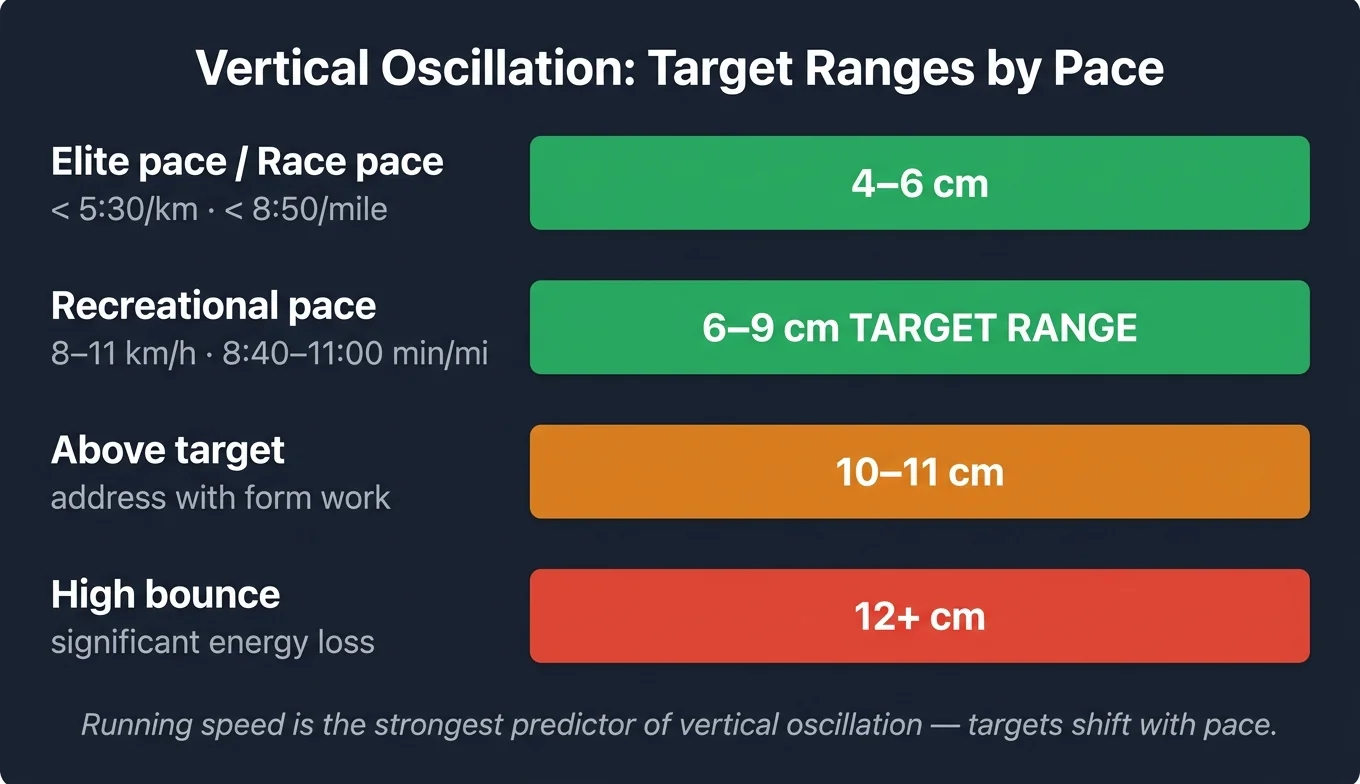
For the majority of recreational runners operating at training paces between 8 and 11 kilometers per hour (roughly 8:40 to 11:00 minutes per mile), a target range of 6 to 9 centimeters is considered efficient. Measurements exceeding 10 centimeters are typically categorized as high-bounce, indicating a clear opportunity for mechanical improvement. At the elite level, where speeds are significantly higher and strides are more compact, vertical oscillation often drops to between 4 and 6 centimeters.
A landmark 2023 study involving 860 non-elite runners highlighted that running speed is the single strongest predictor of vertical oscillation. As a runner accelerates, their stride frequency usually increases, and their flight phase becomes more focused on horizontal distance, naturally reducing vertical travel. This research suggests that runners should evaluate their oscillation numbers relative to their specific training zones rather than comparing an easy recovery run to a high-intensity interval session.
Vertical Ratio: The Contextual Efficiency Metric
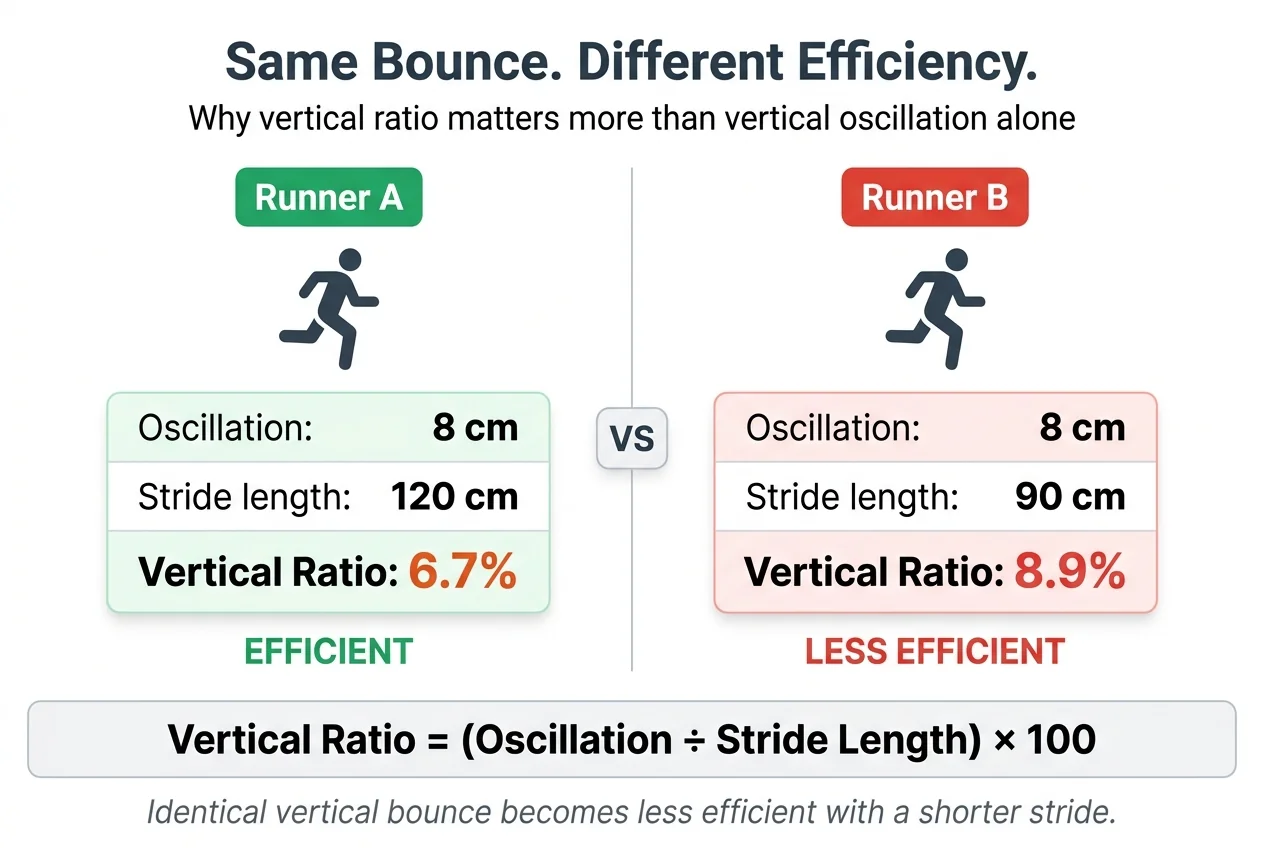
While vertical oscillation provides a raw measurement of bounce, it does not account for how much ground the runner is covering. To address this, the industry adopted the "Vertical Ratio," expressed as a percentage. This metric is calculated by dividing vertical oscillation by stride length and multiplying by 100.
For example, a runner with an 8 cm oscillation and a 120 cm stride length has a vertical ratio of 6.7%. If that same runner maintains the 8 cm oscillation but shortens their stride to 90 cm, their ratio climbs to 8.9%. In the latter scenario, the runner is less efficient because they are spending the same amount of energy on vertical movement while covering less horizontal ground. Most coaches and biomechanists consider a vertical ratio between 6% and 8% to be the "sweet spot" for distance running efficiency.
The Physiological and Safety Implications of High Oscillation
The pursuit of lower vertical oscillation is driven by more than just speed; it is a critical factor in injury prevention. High vertical oscillation is directly correlated with increased ground reaction forces (GRF). When a runner bounces higher, they land with greater force, which must be absorbed by the joints, tendons, and bones.
Research published in the International Journal of Sports Physical Therapy found that reducing vertical oscillation by 10% was more effective at cutting peak ground reaction forces than increasing cadence by the same margin. For a runner logging 30 to 50 miles per week, the cumulative reduction in impact load is substantial. High-oscillation runners often experience greater muscle fatigue in the quadriceps and calves, as these muscles must work harder to decelerate the body upon impact and re-accelerate it upward.
Furthermore, high oscillation is often associated with "overstriding," where the foot lands too far in front of the body’s center of mass. This creates a braking effect that necessitates a more pronounced vertical "pop" to regain momentum, creating a cycle of inefficiency that increases the risk of stress fractures and knee pathologies.
Technical Measurement and Device Accuracy
Accurate measurement of vertical oscillation requires high-frequency accelerometers. Currently, chest-worn sensors such as the Garmin HRM-Pro or HRM-Run remain the industry standard for consumer accuracy. Because these sensors are located near the body’s center of mass (the sternum), they provide a more stable reading than wrist-based sensors, which can be influenced by arm swing.
Alternative methods include waist-mounted pods and, increasingly, AI-driven video analysis apps. While smartphone apps like Runmatic have shown promise, they are often used for periodic checks rather than continuous monitoring during a run. For runners without access to hardware, video analysis remains a viable diagnostic tool. By filming a runner from behind at hip height, coaches can visually identify excessive head movement—a clear proxy for high vertical oscillation.
Strategies for Optimizing Vertical Mechanics
Correcting vertical oscillation is rarely a matter of conscious "bouncing less." Instead, it involves addressing the underlying biomechanical habits that cause the bounce.
1. Cadence Adjustment
Increasing running cadence (steps per minute) is the most immediate way to lower oscillation. By taking more frequent, shorter steps, the body has less time to travel upward between foot strikes. Most experts recommend a target cadence of 170 to 180 steps per minute for efficient running.
2. Forward Lean and Propulsion
Shifting the body’s lean from the waist to the ankles allows the runner to utilize gravity for forward propulsion. A slight lean of 5 to 10 degrees shifts the force vector, ensuring that the power generated by the legs is directed behind the runner rather than straight down into the pavement.
3. Posterior Chain Engagement
Low vertical oscillation is often a sign of "shuffling," where the runner fails to generate enough power to enter a proper flight phase. Conversely, high oscillation can be a sign of weak hip extension. Strengthening the glutes and hamstrings allows for a more powerful "toe-off," which drives the runner forward. Improving hip flexor mobility is also crucial; if the hips are tight, the body cannot extend fully behind, forcing a vertical compensation to complete the stride.
Industry Outlook and Future Implications
As wearable technology continues to evolve, the integration of real-time coaching cues is expected to become standard. Future devices may provide haptic feedback—subtle vibrations—when a runner’s vertical oscillation exceeds a personalized threshold, allowing for "on-the-fly" form corrections.
The democratization of this data has significant implications for the broader running community. Once the exclusive domain of professional athletes, biomechanical optimization is now a tool for the recreational marathoner aiming for a personal best or a fitness runner trying to stay injury-free. By shifting the focus from "how fast" to "how efficiently," the running industry is entering an era where longevity and sustainable performance are prioritized through the lens of data science.
In conclusion, vertical oscillation is more than a secondary statistic on a Garmin dashboard; it is a fundamental metric of human movement. By monitoring and optimizing this "bounce," runners can reduce joint stress, conserve metabolic energy, and achieve a more fluid, efficient gait. As research continues to refine these target ranges, the ability to master one’s vertical oscillation will remain a cornerstone of modern athletic development.